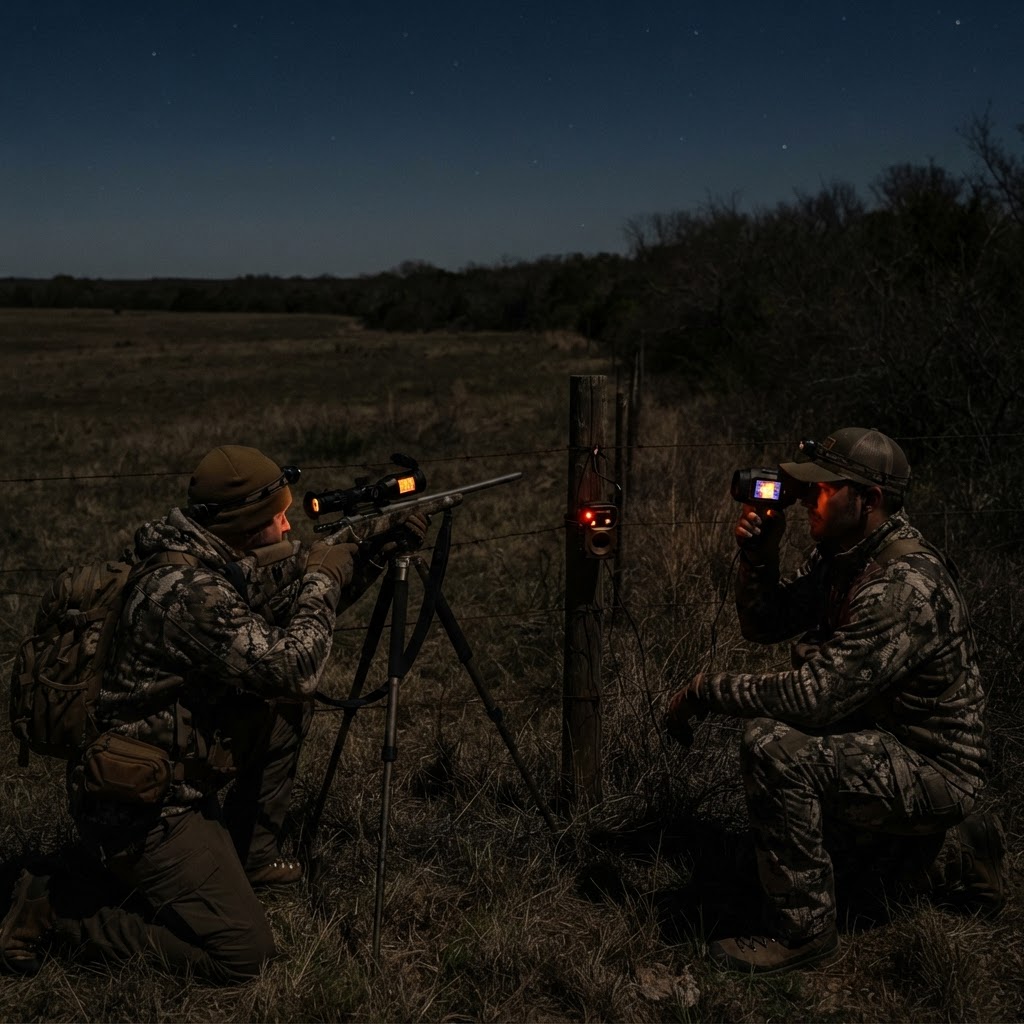

Predator hunting at night demands every advantage you can get. Thermal optics have transformed the sport, letting hunters spot coyotes and hogs at distances that would have been impossible just a decade ago.
At a glance
- Sensor
- 256
- Objective
- 25 mm
- NETD
- 35 mK
- LRF
- No
- Sensor
- 384
- Objective
- 35 mm
- NETD
- 20 mK
- LRF
- No
- Sensor
- 384
- Objective
- 25 mm
- NETD
- 18 mK
- LRF
- No
- Sensor
- 640
- Objective
- 35 mm
- NETD
- 20 mK
- LRF
- Yes
Specification as published by the manufacturer and held in our catalog; price is our current listing.
Why Thermal?
Thermal imagers detect heat signatures, not light. This means they work in total darkness, through light brush, and in foggy or dusty conditions where traditional night vision struggles. For predator hunting, where a target may be behind grass or moving at a trot, that contrast is the difference between seeing the animal and seeing cover.
Sensor Resolution: 256 vs 384 vs 640
The sensor is the heart of any thermal optic. Higher resolution means a more detailed image and a longer detection range, but it also means a higher price tag.
- 256×192: Entry-level. Good for close-range hog hunting (under 150 yards). Budget-friendly.
- 384×288: The sweet spot for most predator hunters. Detection ranges of 400-700 yards depending on the lens. Balances price and performance.
- 640×480: Premium. Detection ranges of 800+ yards with crisp image clarity. Worth it if you hunt open terrain.
Detection Range vs Recognition Range
This is where many beginners get confused. Detection range is the distance at which you can see something is there. Recognition range — the distance at which you can identify the animal — is typically 40-60% of the detection range. A scope that detects at 800 yards may only let you recognize a coyote at 400 yards.
Mounting Options
- Standalone monocular: Best for scanning and spotting. Most hunters start here.
- Clip-on: Mounts in front of your day scope. Lets you use the same rifle day and night without re-zeroing.
- Dedicated thermal scope: Mounts behind your eye like a traditional scope. Best for hunters who exclusively hunt at night.
Budget Picks That Work
You don't need a $4,000 scope to get started. Several scopes in our catalog under $2,000 cover predator hunting well:
- AGM Rattler V2 256 3.5-28x 25mm — $874.50. A 256x192 sensor, 25 mm objective, 35 mK NETD and a 1,200-yard published detection range. The least expensive way into a dedicated thermal scope.
- AGM Rattler V2 384 3-24x 35mm — $1,745. 384x288, 35 mm objective, 20 mK NETD, 1,800-yard published detection. This is the tier most predator hunters settle on.
- ATN THOR-LTV 320 4-12x — $1,795. 25 mm objective, 18 mK NETD and a 2,000-yard published detection range.
If you hunt open country, step up to 640: the AGM Varmint V2 LRF 640 2-16x 35mm runs a 640 sensor, a 35 mm lens and a built-in laser rangefinder for $2,995.
Every scope we list shows its published resolution, objective size, NETD and detection range on the product page, and you can stack any two side by side in our comparison tool.
Tips for Your First Thermal Hunt
- Scan slowly. Thermal reveals heat, but a fast scan will miss animals partially blocked by brush.
- Learn to read heat signatures. Coyotes, hogs, and deer all look different through thermal.
- Practice in daylight first. Get comfortable with the controls before your first night hunt.
- Carry extra batteries. Thermal scopes burn through batteries faster than you'd expect.
Thermal optics are an investment, but they're one of the most effective tools a predator hunter can own. Start with the resolution and detection range that match your typical engagement distance, and you'll be spotting coyotes in the dark before you know it.
How this guide was built
Every model, specification and price in this guide comes from the manufacturer's published documentation and the live listing in our catalog, checked on November 7, 2026. We do not publish test numbers we have not measured: where a figure is the manufacturer's own claim, such as detection range or battery life, it is presented as theirs, and where a specification is not published we say so rather than estimate one. Prices and stock move, so confirm the current figure on the product page before you buy.
Sources
- AGM Global Vision — manufacturer specifications for the models named above
- ATN — manufacturer specifications for the models named above





