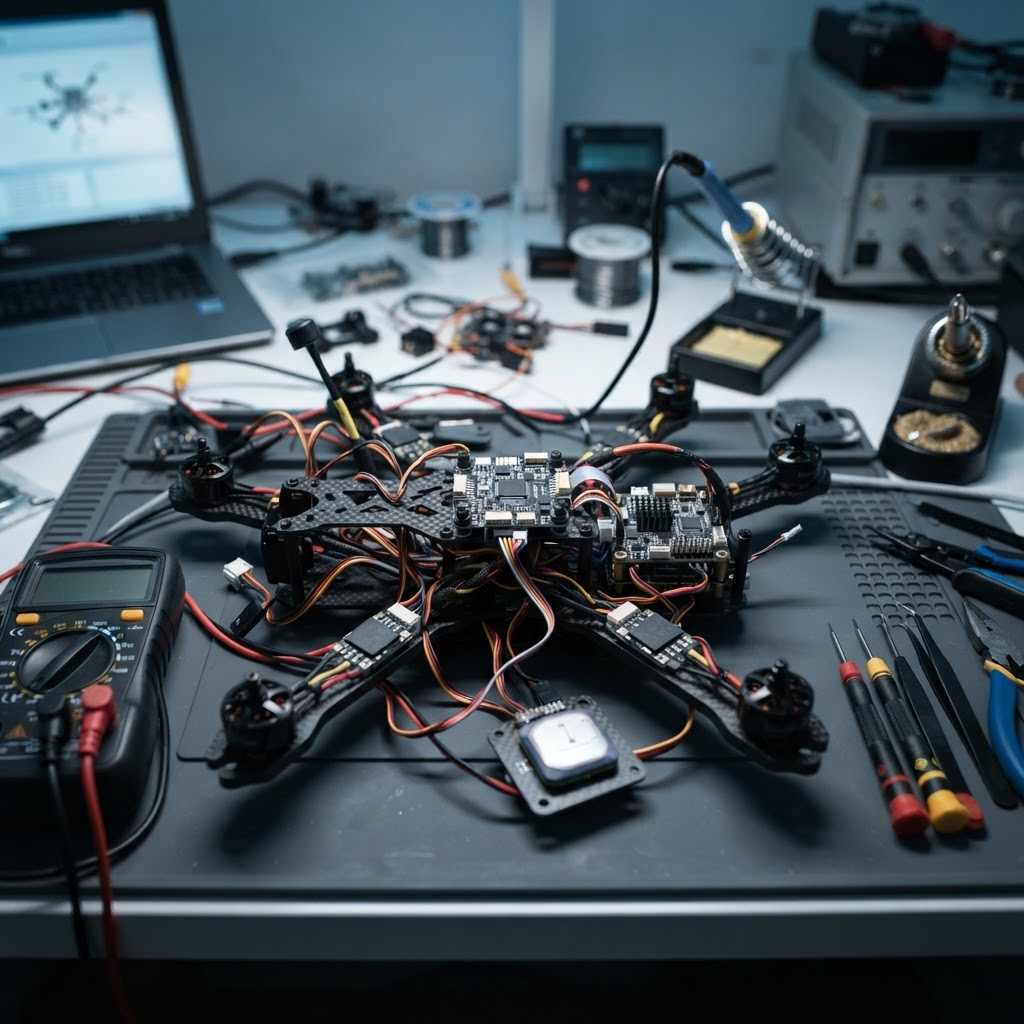

Lead: Custom drone airframes achieve complex operational workflows—such as scripted inspection patterns and georeferenced payload triggering—by pairing the open-source PX4 autopilot with offboard software communicating over MAVLink. Implementing this architecture requires methodical engineering that begins on the workbench and progresses through structured flight testing.
The Stack, in Plain Terms
- The Flight Controller: Runs the PX4 flight stack (typically atop the NuttX real-time operating system), executing estimation, attitude control, stabilization, and core vehicle safety routines as outlined in the PX4 Architectural Overview (PX4 Guide).
- MAVLink: A lightweight binary messaging protocol designed for the drone ecosystem. According to the PX4 MAVLink Messaging Guide, it coordinates telemetry streaming, status reporting, and command delivery across the autopilot, ground control stations (such as QGroundControl), companion computers, and compatible peripherals.
- The Companion Computer: An onboard processor (frequently running Linux) executing high-level robotics software, computer vision, or automated scripts. APIs such as MAVSDK allow developers to send setpoints and read telemetry over high-speed serial or Ethernet connections, as documented in Companion Computers (PX4 Guide).
- The Payload: Triggered either directly by flight controller interfaces (such as PWM or GPIO signals) or commanded via companion computer logic and MAVLink camera protocols.
Build and Testing Sequence
- Bench Assembly and Sensor Calibration: Assemble the airframe, verify electronic speed controller (ESC) connections, and complete full sensor calibrations (IMU, compass, barometer, and airspeed if equipped). Verify motor ordering and spin directions thoroughly before mounting any propellers.
- Staged Manual Flight Checks: Progress systematically through flight modes. Validate control in manual or stabilized modes before testing position estimation and hold. Address any tuning or estimation anomalies before introducing autonomous routines.
- Failsafe Configuration: Configure system responses on the flight controller for communication loss, low battery thresholds, and geofence boundaries. Validate these fallback mechanisms in desktop software-in-the-loop (SITL) simulations before conducting physical tests in a controlled field.
- Telemetry and Interface Verification: Connect the companion computer to the designated autopilot interface (such as
TELEM2or an onboard Ethernet port). Confirm bidirectional MAVLink telemetry is streaming cleanly before issuing offboard setpoints or flight commands. - Incremental Behavior Deployment: Deploy one automated routine at a time. Maintain an active manual override mechanism—such as stick override or an assigned flight mode switch—to retain human-in-the-loop safety during every offboard run.
Operational Safety and Compliance
- Manual Takeover: According to the PX4 Offboard Control Guide, offboard control requires clear override pathways, such as enabling remote control stick override to immediately drop out of offboard mode into position control.
- Onboard Safety Boundaries: Keep geofences and maximum altitude limits enforced directly within flight controller parameters rather than relying exclusively on offboard software scripts.
- Flight Logging: Utilize PX4 onboard ULog telemetry alongside companion-side command logging to analyze state estimations, setpoint tracking, and timing.
- Simulation Validation: Test mission routes and offboard code in desktop simulators prior to physical flight to verify logic states and waypoint transitions.
- Regulatory Alignment: Autonomy does not supersede civil aviation rules. In the United States, operations must comply with FAA Part 107 rules, and beyond-visual-line-of-sight (BVLOS) flights require appropriate waivers and operational authorizations.
Summary
Reliable PX4-based autonomy depends on systematic bench preparation, progressive flight testing, properly calibrated hardware failsafes, and verified communication links rather than complex scripting alone.