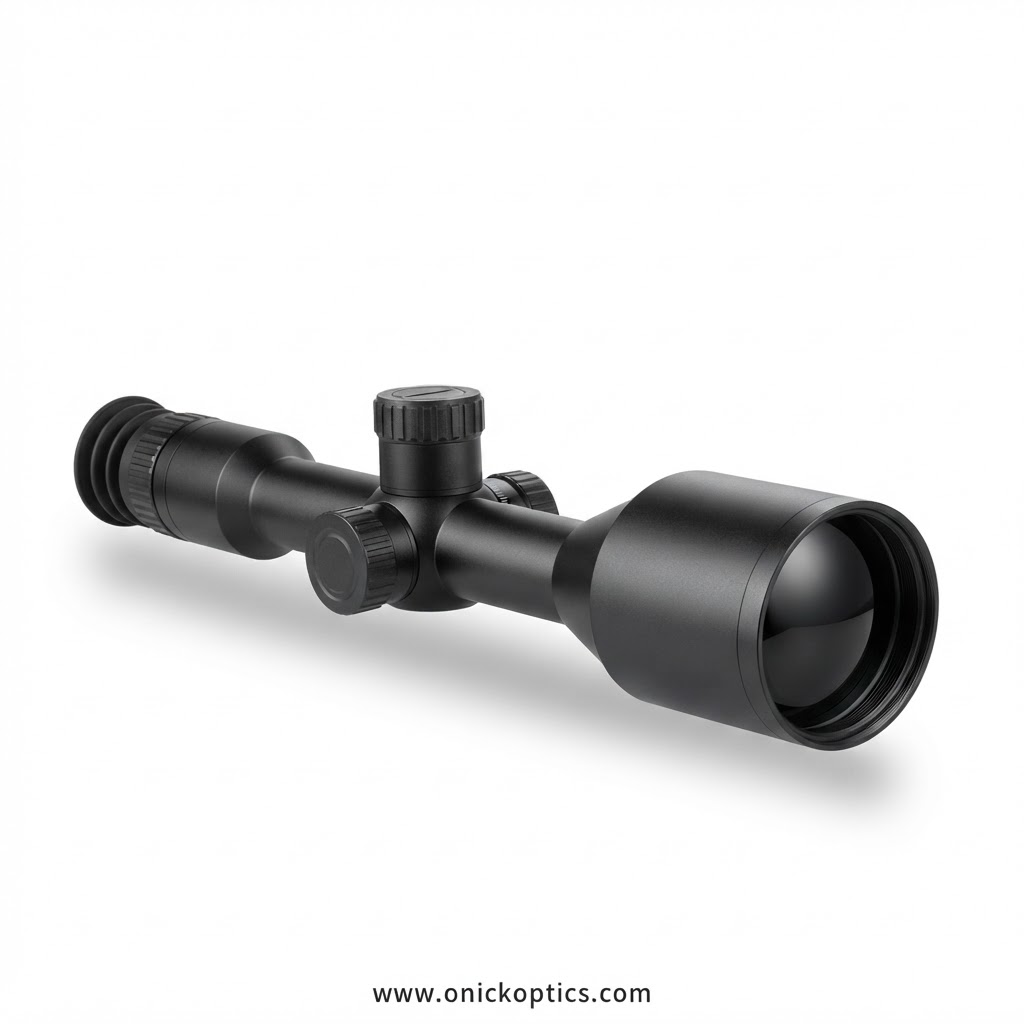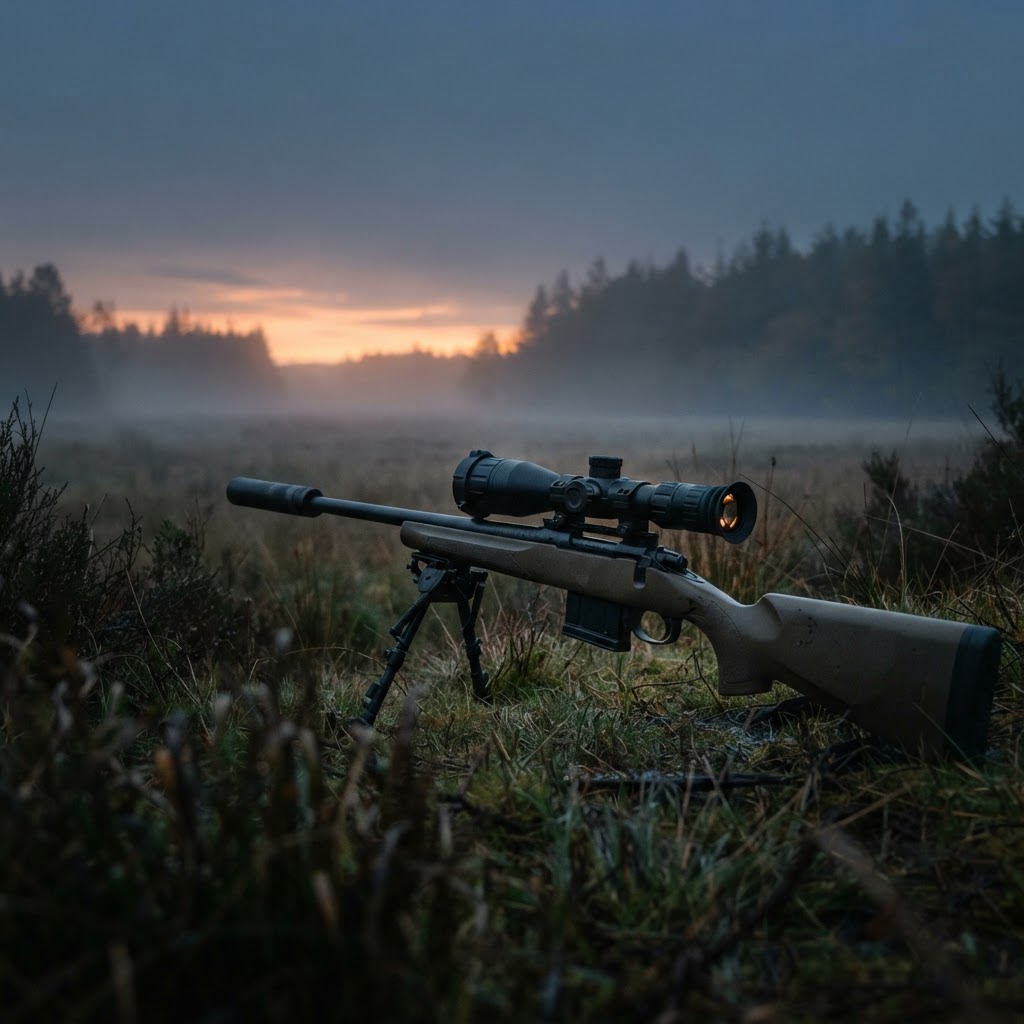

The RM-650 is Onick's answer to a specific kind of hunting: a long sit over ground you already know, where the shot is likely to be inside 300 yards and the scope has to stay awake longer than you do. It is a 640-class riflescope with a 50 mm lens for $2,195, and it sits between the entry RM-335 and the flagship RM-612 family in both price and capability.
What you get for the money
Verified from Onick's own specification sheet, the RM-650 carries:
- 640x512 VOx uncooled sensor, 12 µm pitch, 50 Hz refresh
- 50 mm objective, 8.8° x 7.0° field of view, 1x to 8x digital zoom
- OLED display at 1024x768, 10 colour palettes
- Image modes for forest, desert and city, with brightness and contrast control
- 2,600 m (2,843 yd) human detection range
- 32 GB onboard recording, Type-C charging and data, Wi-Fi on 2.4 GHz to roughly 10 m
- Trigger-activated video recording, selectable reticle types and colours
- 900 G shock resistance on a Picatinny rail mount
- 600 g body, 170 x 63 x 63 mm, IP67, -25 °C to +50 °C
- A single 18500 cell, 5 or more hours of runtime
One thing the sheet does not publish is NETD. Onick lists a sensitivity figure for the RM-612 family (≤30 mK) but not for the RM-650, so treat any third-party sensitivity claim for this scope as unconfirmed and judge it on the image you see through it, not on a number someone typed into a listing.
What it does well
It is light for a 50 mm 640. At 600 g it weighs roughly 430 g less than the RM-612 PRO, and it mounts on a Picatinny rail rather than needing 30 mm rings. On a walking rifle or a rifle you carry to a stand, that difference is felt before the first mile.
The 1x to 8x range is honest field magnification. Low end is wide enough to scan a field edge and pick up heat at distance, and 8x is enough to identify what you found. It is not a precision rig for 400-yard prairie dogs, and Onick does not sell it as one.
Three image modes are more useful than they sound. Forest mode pulls detail out of vegetation clutter; desert mode cuts glare off bare ground and rock. If you hunt the same terrain type all season, you will set one and forget it, but switching between them is the difference between seeing legs under a mesquite and seeing a blur.
What it gives up
- No rangefinder. The RM-650L adds one; the base RM-650 does not. At unknown distances you are estimating or carrying a separate LRF.
- Five hours, one cell. Compared with 12 to 13 hours in the RM-612 family, this is a shorter watch. Carry a spare 18500 and a power bank, because the Type-C port will charge from one.
- No NETD figure. See above. Not a defect, just a missing number.
How it stacks up against the other two Onicks
| RM-335 | RM-650 | RM-612 PRO | |
|---|---|---|---|
| Sensor | 384x288 | 640x512 | 640x512 |
| Objective | 35 mm | 50 mm | 50 mm |
| Zoom | 1x to 4x | 1x to 8x | 2.8x to 22.4x |
| Detection | 1,800 m | 2,600 m | 2,600 m |
| Weight | 540 g | 600 g | 1,030 g |
| Runtime | 5+ hrs | 5+ hrs | 13+ hrs |
| Mount | Picatinny | Picatinny | 30 mm rings |
The RM-335 is the close-range, close-cover option: lighter again, 35 mm lens, 4x ceiling, 1,800 m detection. If your shots live inside 150 yards in timber, the 335 is not a compromise, it is the right tool.
The RM-612 PRO is the dedicated-scope build: the same detector and lens as the 650 but with 22.4x on top, 13 hours of runtime, 6,000 J recoil rating and a 30 mm tube. You pay for that in weight and in price.
The verdict
The RM-650 is the scope to buy when you want a 640 detector and a 50 mm lens without the flagship price or the flagship weight, and when a five-hour watch with a spare cell is acceptable. It is a plain, well-specified riflescope with a light body, a wide zoom range and no published sensitivity claim to argue about.
If your hunting is fixed-position, well-ranged work and you want the lightest 640 you can mount on a rail, this is the value pick in the Onick line. If you need a rangefinder in the same box, step to the RM-612 LRF; if you need the magnification ceiling, step to the RM-612 PRO.