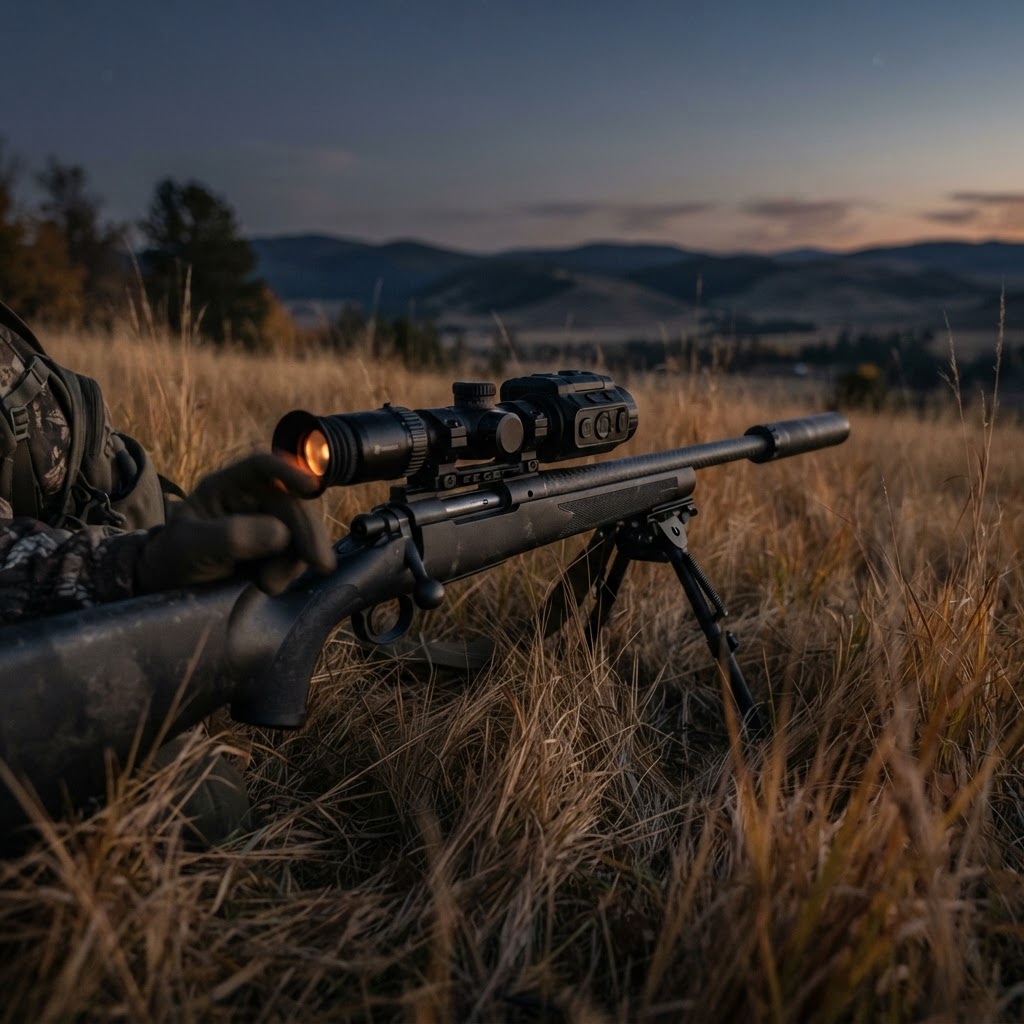
Best Thermal Clip-Ons in 2026: Full Reviews, Pros and Cons
A clip-on is the most misunderstood piece of thermal gear on the market. Mounted in front of a day optic, it converts the rifle you already own into a night rifle and comes off again in the morning — one rifle, one daylight zero, and a device that moves between guns.
Two things are worth knowing before the reviews, because they change how you buy:
- A clip-on is aligned, not zeroed. Your day optic keeps its zero. The clip-on's job is to lay a thermal image onto that optic's sight picture, and its own X/Y offset corrects for the mount. If a clip-on will not group, the first thing to check is the mount interface, not the detector.
- The day optic magnifies the clip-on's image. A 256-detector clip-on behind a 3-9x is perfectly usable; the same clip-on behind a 6-24x is a blocky mess. The clip-on and the scope behind it are one system, so buy the pair, not the device.
Every scope below is one we carry, with the manufacturer's published specification from our catalog. Prices and stock move, so confirm on the product page.
What actually matters in a clip-on
Objective and sensor together. A 25 mm lens keeps the field of view wide for timber and feeders; 35 mm is the all-rounder; 50 mm is for open country. The sensor behind it decides how much detail survives, which is why the pairing matters more than either number alone.
NETD (sensitivity). Lower is better. Under about 20 mK the image holds contrast on a mild, humid night; at 35 mK it flattens when the temperature spread between animal and ground is small.
Mount repeatability. A clip-on only earns its place if it goes back on the same way every time. Look for a solid interface and a device you can re-seat without tools.
Weight and balance. A clip-on hangs off the front of the scope, where its weight is most noticeable. Anything heavy changes how the rifle handles from a stand.
Warranty. It ranges from 36 months on AGM's clip-on line to 60 months on ATN and SIG at this tier, and it is the cheapest insurance on a thermal you will ever buy.
Quick comparison: clip-ons we carry
| Clip-on | Price | Sensor | Objective | NETD | Warranty | Best for | | --- | --- | --- | --- | --- | --- | --- | | AGM Rattler-C V2 19 256 | $975 | 256×192 | 19 mm | ≤35 mK | 36 mo | First clip-on, close cover | | ATN TICO 6 225 | $1,205 | 256×192 | 25 mm | ≤20 mK | 60 mo | Budget with a long warranty | | AGM Rattler-C V2 35 384 | $2,195 | 384×288 | 35 mm | ≤20 mK | 36 mo | Best all-round value | | ATN TICO 6 335 | $2,415 | 384×288 | 35 mm | ≤18 mK | 60 mo | Best sensitivity at mid-price | | Burris BTC 35 V3 | $2,999.99 | 384 | 35 mm | — | 36 mo | A different reticle ecosystem | | AGM Rattler-C V2 50 640 | $3,795 | 640×512 | 50 mm | ≤20 mK | 36 mo | Long shots in open country | | ATN TICO 6 650 | $4,285 | 640×512 | 50 mm | ≤18 mK | 60 mo | Most complete clip-on we carry | | SIG Echo CV25 | $4,499.99 | 384 | 25 mm | ≤20 mK | 60 mo | SIG ecosystem and warranty |
The reviews
AGM Rattler-C V2 19 256 — $975
Check the live price and stock →
The cheapest real clip-on we carry, and a genuine entry point.
A 256×192 detector behind a 19 mm lens gives the widest field of view in this group, which is exactly what you want for hogs at a feeder or a treeline 80 yards out. Paired with a low-power variable scope it does the job; paired with a 6-24x it does not.
Pros
- Under $1,000 with a 36-month warranty
- Widest field of view here — fast to scan cover
- Light enough that it does not wreck the rifle's balance
- The cheapest way to find out whether clip-on shooting suits you
Cons
- 256 pixels limit identification to close range
- ≤35 mK sensitivity flattens on mild, humid nights
- Wants a low-magnification day optic behind it — do not buy this for a high-power scope
Buy it if your shots are inside about 150 yards and you already own a 1-6x or 2-10x.
ATN TICO 6 225 — $1,205
Check the live price and stock →
The budget pick with the specification that actually holds up.
Same 256×192 class detector as the Rattler-C entry, but with a 25 mm lens for a little more reach and ≥20 mK sensitivity that is a real step up in contrast — and ATN backs it with a 60-month warranty.
Pros
- 20 mK contrast at just over $1,200
- 60-month warranty, the longest in the budget tier
- 25 mm objective splits the difference between wide and long
Cons
- Still a 256 detector behind a modest lens
- ATN's app and firmware workflow takes learning
- Slightly heavier than the AGM entry model
Buy it if you want a budget clip-on that still works on a mild night and you keep gear for years.
AGM Rattler-C V2 35 384 — $2,195
Check the live price and stock →
Best all-round value, and the clip-on most hunters should buy.
A 384×288 detector behind a 35 mm objective at ≤20 mK is the same core specification that makes the Rattler V2 384 the value pick among scopes — and it moves between rifles without disturbing a single daylight zero.
Pros
- 384 pixels put real detail on the reticle at 150–250 yards
- 35 mm objective is the versatile middle
- 20 mK contrast on mild nights
- 36-month warranty at a mid-tier price
Cons
- Alignment correction, not zeroing — expect a short session at the range with your day optic
- No ranging capability
- The 640/50 mm version costs $1,600 more
Buy it if you want one device for several rifles and hunt out to about 250 yards.
ATN TICO 6 335 — $2,415
Check the live price and stock →
The most sensitive clip-on under $2,500.
≤18 mK sensitivity with a 384 detector and a 35 mm lens, plus a 60-month warranty. On a warm, humid September night this is the clip-on that still shows an animal's outline rather than a grey silhouette.
Pros
- 18 mK is the lowest NETD in this tier
- 60-month warranty
- Ballistic and recording features built into the ATN ecosystem
Cons
- About $220 more than the AGM for the same sensor class
- Heavier than the AGM equivalent, and the weight sits forward
- Menu depth you may never use
Buy it if you hunt in humid conditions where contrast matters more than price.
Burris BTC 35 V3 — $2,999.99
A different ecosystem at the same money. A 384 detector and 35 mm lens from a company with a long optics pedigree. It was out of stock when we last updated this guide, so check availability before you plan around it — and compare it against the TICO 6 335 on NETD, which Burris does not publish here.
Pros
- 384 / 35 mm is the proven all-round pairing
- 36-month warranty
- Burris reticle and mounting heritage
Cons
- No published NETD in our catalog, so contrast cannot be compared on paper
- Out of stock at the time of writing
- Priced against 640-class competition
Buy it if you already run Burris optics and want the ecosystem to match.
AGM Rattler-C V2 50 640 — $3,795
Check the live price and stock →
The long-range clip-on: most pixels behind the longest lens.
A 640×512 detector with a 50 mm objective is the combination for bean fields and cut corn, where the animal is 300 yards out and the question is whether the shape is worth a stalk. Clip-on form means your day scope's reticle and holdover come with it.
Pros
- 640 pixels behind 50 mm is the longest usable reach here
- Keeps your day optic, its zero and its reticle
- 20 mK sensitivity, 36-month warranty
Cons
- Narrow field of view makes scanning work
- $3,795 is real money for a device that cannot be used on its own
- Heavy on the front of a light rifle
Buy it if your hunting is long and open, and you want one rifle that works day and night.
ATN TICO 6 650 — $4,285
Check the live price and stock →
The most complete clip-on we carry.
640×512 behind a 50 mm lens with ≤18 mK sensitivity, a 60-month warranty, and the ATN recording and ballistic toolkit. If you want the best image a clip-on can produce plus the longest coverage, this is the end of the road in this format.
Pros
- 640 detector, 50 mm objective and 18 mK together
- 60-month warranty
- Records and integrates with ATN's ballistic tools
Cons
- The most expensive clip-on here except the SIG
- Heavy, forward-weighted and app-dependent
- At this price a dedicated 640 scope is a serious alternative — decide whether you need the day-rifle flexibility
Buy it if you want maximum clip-on performance and the warranty to match.
SIG Echo CV25 — $4,499.99
Check the live price and stock →
Premium build, premium warranty, wide field of view.
A 384 detector behind a 25 mm lens at ≤20 mK with a 60-month warranty. The 25 mm lens is the interesting choice at this price — it prioritises field of view and fast target acquisition over standoff, which suits close-and-fast hog work more than long-range precision.
Pros
- 60-month warranty at the top of the range
- 25 mm lens gives a fast, wide picture
- SIG ecosystem and build quality
Cons
- $4,499.99 for a 384 detector, when a 640 clip-on costs less
- Wide lens limits identification at distance
- No rangefinder
Buy it if you shoot fast at close range and value the warranty and brand support over raw specification.
Budget thermal imaging scopes: clip-ons under $1,200
Budget in this format is narrow, because there is only one sub-$1,200 clip-on we carry — and one honest step above it. That is not a shortage, it is the shape of the market: a clip-on needs a display, a mount and alignment electronics, so the cheap end of the category lives around $1,000–$1,200.
Budget clip-on comparison table
| Clip-on | Price | Sensor | Objective | NETD | Warranty | The honest job | | --- | --- | --- | --- | --- | --- | --- | | AGM Rattler-C V2 19 256 | $975 | 256×192 | 19 mm | ≤35 mK | 36 mo | Close cover behind a 1-6x — inside ~150 yd | | ATN TICO 6 225 | $1,205 | 256×192 | 25 mm | ≤20 mK | 60 mo | Same job with better contrast and a 5-year warranty |
How to buy a budget clip-on without wasting money
- Match it to the day optic you already own. A 256-detector clip-on is excellent behind 1-6x and unusable behind 6-24x, because the day scope magnifies the clip-on's image. If your rifle wears a high-power scope, budget for a 384 clip-on instead.
- Take the lower NETD. Between two budget clip-ons, sensitivity decides whether the image survives a mild, humid night — and that is the night most pigs get shot.
- Test the mount ten times before you trust it. Remove and refit the clip-on, then confirm the day optic's zero is unchanged and the thermal image still lines up. A clip-on that shifts is worse than no clip-on.
- Do not buy zoom. Every budget device advertises a big magnification range; all of it past about 2x is digital and adds pixels rather than information.
- Accept the ceiling. A budget clip-on finds animals. It does not identify them across a field. If your shots regularly run past 200 yards, save for a 384 or 640 rather than buying twice.
How we picked these
Every figure is the manufacturer's published specification from the product record in our catalog, and every pick is a clip-on we carry. Where a maker does not publish a figure we leave it out instead of estimating — which is why some NETD cells are empty. Prices, availability and MAP-controlled pricing are live on each product page and change with the manufacturer, so confirm before you buy.
Compare any two clip-ons side by side
Our comparison tool stacks any two optics against each other — resolution, objective, NETD, price and more — so the final call is made with the numbers in front of you.


