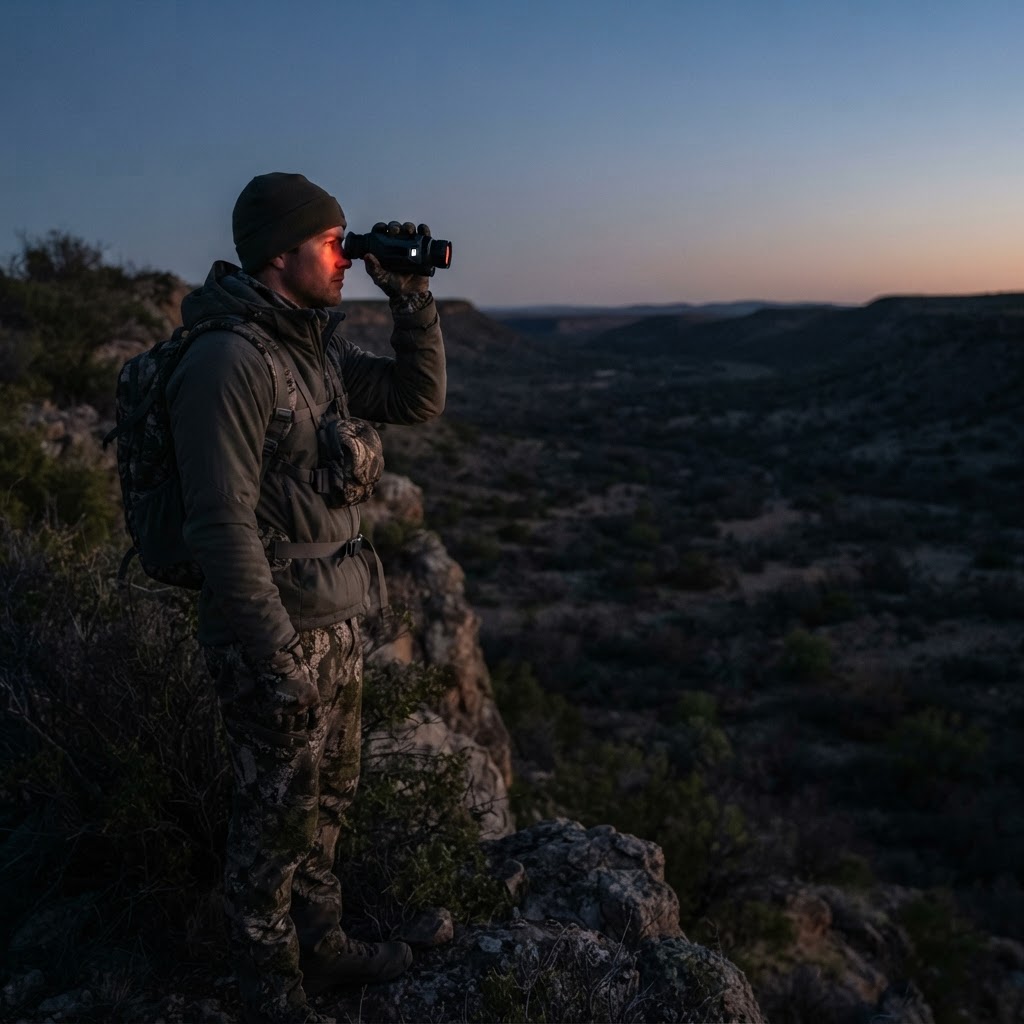
Best Thermal Monoculars in 2026: Full Reviews, Pros and Cons
A thermal monocular is the tool that makes the rest of your thermal gear worth owning. You cannot shoot what you cannot find, and no scope — at any price — replaces a handheld you can sweep across a field for an hour without pointing a rifle at it.
Two ways to buy, and they are different products:
- A wide, light scanner. A 10–25 mm lens with a modest detector gives a big field of view, fits a pocket and runs all night. This is what most people actually need first.
- A ranging spotter. Add a laser rangefinder and the same device starts feeding numbers to your shot — worth the money if your scope has no rangefinder of its own.
Every monocular below is one we carry, with the manufacturer's published specification from our catalog. Prices and stock move, so confirm on the product page.
What actually matters in a monocular
Field of view and base magnification. A wide field of view is what lets you sweep quickly without losing your place. Digital zoom is not magnification in any useful sense — it enlarges pixels — so judge the device on its base magnification and its lens, not its maximum zoom claim.
Lens size. 10–15 mm is an inside-200-yards scanner; 19–25 mm is the all-rounder; 35–50 mm is a spotter for open country.
Detector and NETD. For pure detection a 256 detector is plenty, because you are looking for a heat signature, not counting whiskers. NETD decides whether the signature survives a mild night.
A rangefinder, or not. A monocular with LRF gives you distance before you touch the rifle, which is the single most useful piece of information in night hunting.
Battery and weight. You will hold this device for hours. Anything over about 20 oz gets left in the truck.
Quick comparison: monoculars we carry
| Monocular | Price | Sensor | Objective | NETD | LRF | Warranty | Best for | | --- | --- | --- | --- | --- | --- | --- | --- | | AGM Taipan V2 10 256 | $545 | 256×192 | 10 mm | ≤35 mK | No | 36 mo | Cheapest real scanner | | ATN Blaze Seeker 210 | $626 | — | 10 mm | — | No | 60 mo | Budget with a long warranty | | AGM Taipan V2 15 256 | $645 | 256×192 | 15 mm | ≤35 mK | No | 36 mo | Best sub-$700 balance | | AGM Taipan V2 19 320 | $755 | 320 | 19 mm | ≤35 mK | No | 36 mo | Sub-$800 all-rounder | | ATN Blaze Trek 319 | $1,095 | — | 19 mm | — | No | 60 mo | Light pocket scanner | | AGM Taipan V2 19 384 | $1,395 | 384×288 | 19 mm | ≤20 mK | No | 36 mo | Contrast on a budget | | AGM Taipan V2 25 384 | $1,695 | 384×288 | 25 mm | ≤20 mK | No | 36 mo | Best mid-price scanner | | ATN Blaze Hunter LRF 335 | $2,085 | — | 35 mm | — | Yes | 60 mo | Ranging on a mid budget | | AGM Reach IR LRF 25 384 | $2,195 | 384 | 25 mm | ≤20 mK | Yes | 36 mo | Wide view with ranging | | AGM Reach IR LRF 35 640 | $2,695 | 640 | 35 mm | ≤20 mK | Yes | 36 mo | Cheapest 640 spotter with LRF | | AGM Reach IR LRF 50 640 | $2,795 | 640 | 50 mm | ≤20 mK | Yes | 36 mo | Long-range spotting | | SIG Echo MV35 | $2,499.99 | — | 35 mm | — | No | 60 mo | Warranty-led mid pick | | SIG Echo MV50-LRF | $3,299.99 | — | 50 mm | — | Yes | 60 mo | Long range plus warranty |
The reviews
AGM Taipan V2 10 256 — $545
Check the live price and stock →
The cheapest way to learn thermal, and it is not a toy.
A 10 mm lens gives the widest field of view here — you sweep a treeline and see the whole thing at once. A 256×192 detector is enough for detection, which is the monocular's job.
Pros
- Under $550 with a 36-month warranty
- Widest field of view in this lineup — fastest to scan
- Small and light enough to live in a jacket pocket
- Perfect first thermal: it teaches you how animals read in infrared
Cons
- ≤35 mK sensitivity flattens on mild nights
- 256 pixels will not identify at distance, and it is not meant to
- Not a ranging device
Buy it if you are buying your first thermal and want to find animals before you spend scope money.
ATN Blaze Seeker 210 — $626
Check the live price and stock →
A budget scanner with a five-year warranty.
A 10 mm lens in ATN's compact body, backed by 60 months of coverage — which at this price is the standout feature. ATN does not publish a detector figure for this model in our catalog, so compare it on lens, weight and warranty rather than on a sensor number.
Pros
- 60-month warranty at under $650
- Very light — one of the smallest devices here
- Wide 10 mm lens for fast sweeping
Cons
- No published detector or NETD figure in our catalog, so specification comparison is limited
- ATN's app and menu workflow takes learning
- Base specification is entry level
Buy it if warranty length and compact size matter more to you than a published sensor figure.
AGM Taipan V2 15 256 — $645
Check the live price and stock →
The best balance under $700.
A 15 mm lens sits between the wide-angle 10 mm and the more focused 19 mm, and it is the most versatile of the budget Taipans: still wide enough to sweep, with enough reach that an animal at 150 yards is recognisably an animal.
Pros
- 15 mm lens is the budget sweet spot for field of view versus reach
- 256×192 detector is adequate for detection
- Cheapest Taipan with a genuinely all-round field of view
- 36-month warranty
Cons
- ≤35 mK sensitivity, so mild humid nights cost you contrast
- Digital zoom past 2x is unusable for identification
- No rangefinder
Buy it if you want one budget monocular that does not feel like a compromise.
AGM Taipan V2 19 320 — $755
Check the live price and stock →
Under $800 with the reach of a 19 mm lens.
A 320-class detector behind 19 mm gives noticeably more detail than the 256 units while keeping a field of view you can sweep with. This is the sensible ceiling of the budget tier.
Pros
- More pixels on target than the 256 models for about $200 more
- 19 mm lens reaches further without becoming a telescope
- 36-month warranty
- Still a pocket-sized device
Cons
- ≤35 mK sensitivity
- No rangefinder
- The step to a 384 with 20 mK is $640, and it is a bigger jump than it looks
Buy it if you want a budget scanner for 150–250 yard detection.
ATN Blaze Trek 319 — $1,095
Check the live price and stock →
The light one.
A 19 mm lens in ATN's lightest body — around 1.9 lb — with a 60-month warranty. For a device you carry all night, that weight difference is felt by hour three.
Pros
- Very light for a 19 mm device
- 60-month warranty
- Records and connects to ATN's app
Cons
- No published detector or NETD figure in our catalog
- ATN's app and firmware workflow takes learning
- Priced against AGM's 384 with 20 mK at $1,395
Buy it if weight is your first criterion and you want a long warranty.
AGM Taipan V2 19 384 — $1,395
Check the live price and stock →
The first monocular where contrast stops being the limiting factor.
384×288 with ≤20 mK sensitivity behind a 19 mm lens. That combination is the real upgrade in this lineup: the image holds up on a warm night instead of washing out, and an animal at 250 yards has a shape rather than a blob.
Pros
- 20 mK sensitivity — a genuine step in contrast
- 384 pixels for identification, not just detection
- 19 mm lens balances field of view and reach
- 36-month warranty
Cons
- No rangefinder at $1,395
- More expensive than several scopes-adjacent options
- The 25 mm version is only $300 more for more reach
Buy it if you scan in mild or humid conditions where a 35 mK device disappoints you.
AGM Taipan V2 25 384 — $1,695
Check the live price and stock →
Best mid-price scanner for open ground.
The 25 mm lens trades a little field of view for real standoff, and with 384 pixels and 20 mK behind it this is the monocular that handles a bean field as well as a treeline.
Pros
- 25 mm lens reaches across open ground
- 384 detector with 20 mK sensitivity
- 36-month warranty
- Comfortable as a primary finding tool
Cons
- Narrower field of view than the 19 mm, so sweeping takes longer
- No rangefinder
- Adds weight over the pocket models
Buy it if you hunt fields and clearings rather than timber.
ATN Blaze Hunter LRF 335 — $2,085
Check the live price and stock →
The cheapest route to ranging in a monocular.
A 35 mm lens with a built-in laser rangefinder and a 60-month warranty. Distance before you touch the rifle is the most useful thing a handheld can give you, and this is the least expensive way to get it here.
Pros
- Laser rangefinder at just over $2,000
- 60-month warranty
- 35 mm lens for open-country spotting
Cons
- No published detector or NETD figure in our catalog
- Narrow field of view for close cover
- ATN's menu and app workflow takes learning
Buy it if you want ranging without paying AGM or SIG prices.
AGM Reach IR LRF 25 384 — $2,195
Check the live price and stock →
Wide field of view plus a rangefinder.
384 pixels, 20 mK sensitivity and a 25 mm lens with a built-in LRF — a combination that suits the way most people actually hunt: sweep wide, range the animal, then decide.
Pros
- LRF plus a 25 mm lens keeps the field of view usable
- 20 mK sensitivity, 384 detector
- 36-month warranty
Cons
- $500 more than the same device without ranging
- Heavier than the Taipan line
- 384 rather than 640, so standoff has a ceiling
Buy it if you want one handheld that both finds and ranges, without going to 640 money.
AGM Reach IR LRF 35 640 — $2,695
Check the live price and stock →
The cheapest 640 spotter with a rangefinder that we carry.
640 pixels, a 35 mm lens, 20 mK sensitivity and a built-in LRF. Nearly three times the pixels of a 384 means an animal at 400 yards has an outline you can judge, which is what a spotter is for.
Pros
- 640 detector and LRF together for under $2,700
- 35 mm lens for open country
- 20 mK sensitivity, 36-month warranty
Cons
- Narrow field of view for tight cover
- Heavier than the pocket scanners
- Only $100 less than the 50 mm version, which reaches further
Buy it if you want maximum identification at distance in a handheld.
AGM Reach IR LRF 50 640 — $2,795
Check the live price and stock →
The long-range spotter, for $100 more than the 35 mm.
A 50 mm lens behind a 640 detector with an LRF — the device for glassing a field edge 600 yards away and knowing whether it is worth a walk. The field of view is deliberately tight; this is not a close-cover tool.
Pros
- Longest reach in this lineup
- 640 pixels and 20 mK behind a 50 mm lens
- Built-in rangefinder
- 36-month warranty
Cons
- Very narrow field of view — slow to sweep with
- Marginal as a general-purpose scanner
- $2,795 is scope money for a handheld
Buy it if your hunting is open country and you already have a way to scan close.
SIG Echo MV35 — $2,499.99
Check the live price and stock →
A 35 mm spotter with a five-year warranty.
SIG's mid-size handheld: a 35 mm lens, a 60-month warranty and SIG's ecosystem. SIG does not publish a detector figure for this model in our catalog, so judge it on lens, warranty and handling rather than on a sensor number.
Pros
- 60-month warranty
- 35 mm lens for open country
- SIG build and support
Cons
- No published detector or NETD figure in our catalog
- No rangefinder at $2,500 — the MV50-LRF is $800 more
- Priced against 640 devices that publish more
Buy it if you value warranty and brand support over published specification.
SIG Echo MV50-LRF — $3,299.99
Check the live price and stock →
Long range, ranging and a five-year warranty in one handheld.
A 50 mm lens with a built-in LRF and 60 months of coverage. This is the premium end of the category: a spotter for open country, backed by the longest warranty here.
Pros
- 50 mm lens plus LRF — the long-range combination
- 60-month warranty
- Full SIG ecosystem
Cons
- $3,299.99 is well above AGM's 640/50 mm with LRF at $2,795
- No published detector figure in our catalog
- Heavy and specialised — poor at close cover
Buy it if warranty and brand support justify the premium for you.
Budget thermal imaging scopes: monoculars under $1,000
This is the best-value corner of the entire thermal market. For the price of a mid-range riflescope mount you can put a real, warrantied thermal detector in your pocket — and for finding animals, a cheap monocular adds more to your success than an expensive scope upgrade.
Budget monocular comparison table
| Monocular | Price | Sensor | Objective | NETD | Warranty | The honest job | | --- | --- | --- | --- | --- | --- | --- | | AGM Taipan V2 10 256 | $545 | 256×192 | 10 mm | ≤35 mK | 36 mo | Widest sweep, inside 150 yd | | ATN Blaze Seeker 210 | $626 | — | 10 mm | — | 60 mo | Same job, five-year warranty | | AGM Taipan V2 15 256 | $645 | 256×192 | 15 mm | ≤35 mK | 36 mo | Best all-round budget scanner | | AGM Taipan V2 19 320 | $755 | 320 | 19 mm | ≤35 mK | 36 mo | Budget with reach to 250 yd |
How to buy a budget thermal imaging scope without wasting money
- Buy field of view first. The cheapest monoculars win on the specification that matters most for finding animals: a 10–15 mm lens sees a whole treeline at once. A narrow lens on a budget detector is the worst of both worlds.
- Ignore the zoom figure. Every budget device advertises 10x or more, and all of it past about 2x is digital — it enlarges pixels rather than resolving them. Compare base magnification and lens instead.
- A 256 detector is enough here. For detection you need a heat signature, not detail. Spending the difference on a lower NETD (20 mK rather than 35 mK) buys more visible improvement than spending it on pixels.
- Check the warranty. It is 36 months on AGM's Taipan line and 60 months on ATN's, and at this price the warranty is a large part of the value.
- Plan the second purchase. The usual path is a budget monocular now, then a scope or clip-on once you know how animals behave in infrared. Buying an expensive monocular first and no scope is the classic mistake in the opposite direction.
How we picked these
Every figure is the manufacturer's published specification from the product record in our catalog, and every pick is a monocular we carry. Where a maker does not publish a detector or NETD figure we leave the cell empty rather than estimating it. Prices, availability and MAP-controlled pricing are live on each product page, so confirm before you buy.
Compare any two monoculars side by side
Our comparison tool stacks any two optics against each other — resolution, objective, NETD, price and more.


