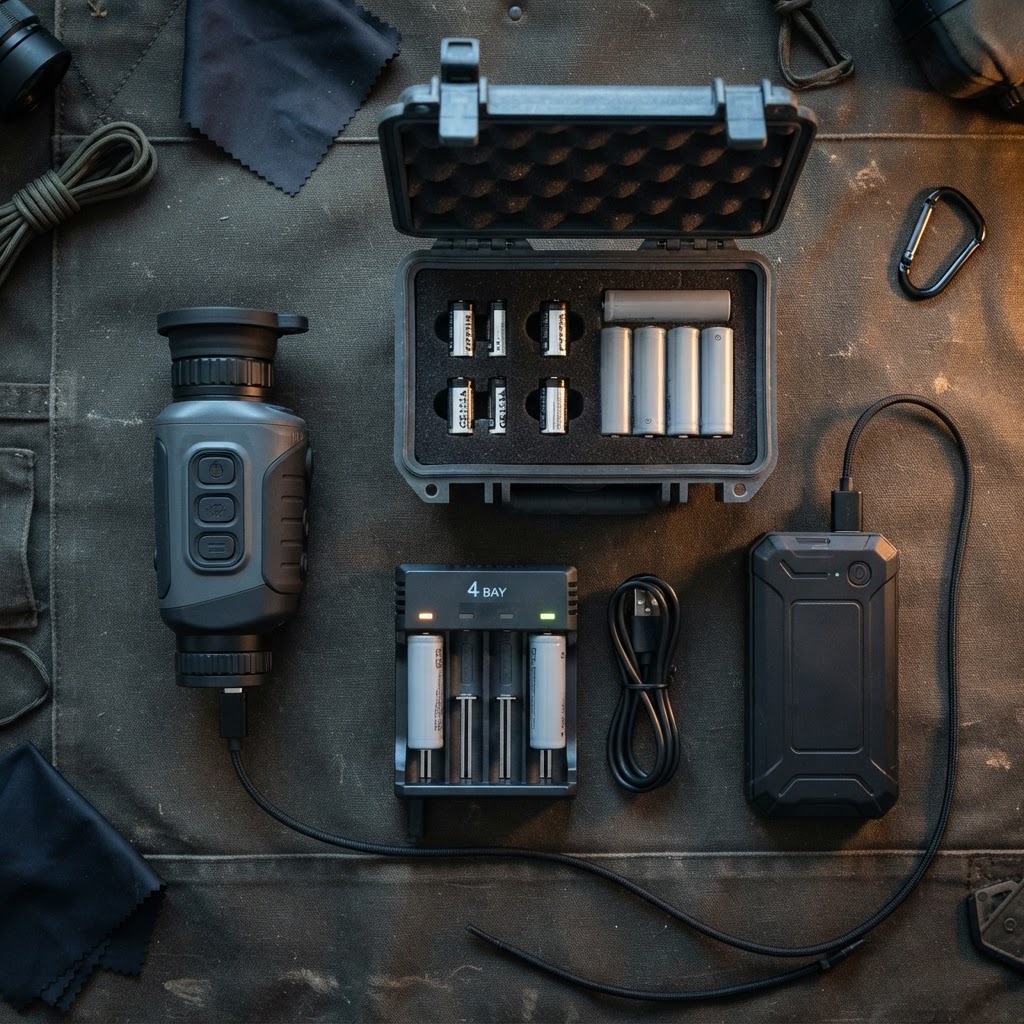

Lead: A thermal scope or monocular relies entirely on consistent electrical power to drive its sensor, display, and processing core. Managing batteries systematically rather than estimating runtime in the field prevents premature shutdowns during observation and night hunts.
Know what your device draws
Thermal devices draw steady power to run microbolometers, internal image processing, display screens, and wireless links. Stated runtime benchmarks are typically measured in controlled ambient conditions. For instance, AGM Global Vision product datasheets for optics like the Clarion specify up to 8.5 to 11 hours of battery life at 25°C with the Wi-Fi hotspot turned off, and Yubeen documentation records a reference of at least 5 hours under the same 25°C baseline with Wi-Fi disabled.
In field scenarios, several operational and environmental factors reduce runtime below factory ratings:
- Wireless connectivity: Operating active Wi-Fi hotspots and video streaming increases power drain.
- Sub-freezing temperatures: Pixfra thermal guides note that low temperatures reduce the usable capacity and power output of lithium-ion cells without altering the base device hardware.
- Display and recording loads: Increased screen brightness settings, onboard audio/video recording, and sensor processing steadily increase device draw.
Battery formats across thermal optics
Manufacturers employ distinct battery systems across optic lines:
- Replaceable Lithium-Ion Cells and Packs: Many AGM thermal scopes and clip-ons use removable rechargeable lithium batteries, such as standard 18650 cells, proprietary NE-4400 (4,400 mAh), or NE-7255 packs, often shipping with two batteries included for field rotation.
- Dual Internal and Removable Systems: Certain optics combine internal rechargeable cells with a secondary replaceable 18650 battery to allow battery swaps without powering down the device.
- External 5V USB Supplies: Modern units such as the AGM Rattler-C V2 series provide 5V DC (2A) USB Type-C ports for external power banks.
The charging routine that works
- Charge ahead of the hunt at moderate ambient temperatures: Lithium-ion cells should be charged inside manufacturer-recommended temperature windows (typically 0°C to 45°C / 32°F to 113°F, as detailed in Pulsar user manuals and ATN technical guides).
- Disconnect once charging completes: Avoid leaving batteries connected to active chargers indefinitely once full capacity is reached.
- Carry and rotate dedicated spare cells: Models with removable compartments allow hunters to cycle fresh packs before voltage drops cause unexpected device shutdowns.
- Keep spare batteries warm: Keeping spare cells in an inside jacket pocket close to body heat prevents cold soak before insertion into the optic.
- Maintain storage charge levels: For seasonal or long-term storage, lithium batteries should be stored in dry, temperate environments at a partial charge (typically between 50% and 80%) rather than fully depleted, and refreshed periodically as noted in Athlon Optics maintenance instructions.
What degrades battery service life
- Extreme heat exposure: Leaving batteries in hot vehicles or directly behind windshields accelerates chemical degradation.
- Charging cold or frozen packs: As documented in Pulsar technical instructions, never charge battery packs immediately after bringing them in from freezing environments; allow cells to acclimate for 30–40 minutes before connecting power.
- Deep long-term discharge: Storing lithium batteries completely drained over extended off-seasons causes irreversible capacity loss.
Field discipline
Carry compatible, verified battery packs designed for your device model, and swap them proactively based on elapsed operating time and weather conditions. Documenting your actual hours of operation across varying temperature bands provides an accurate, realistic runtime baseline for your specific hardware configuration.





