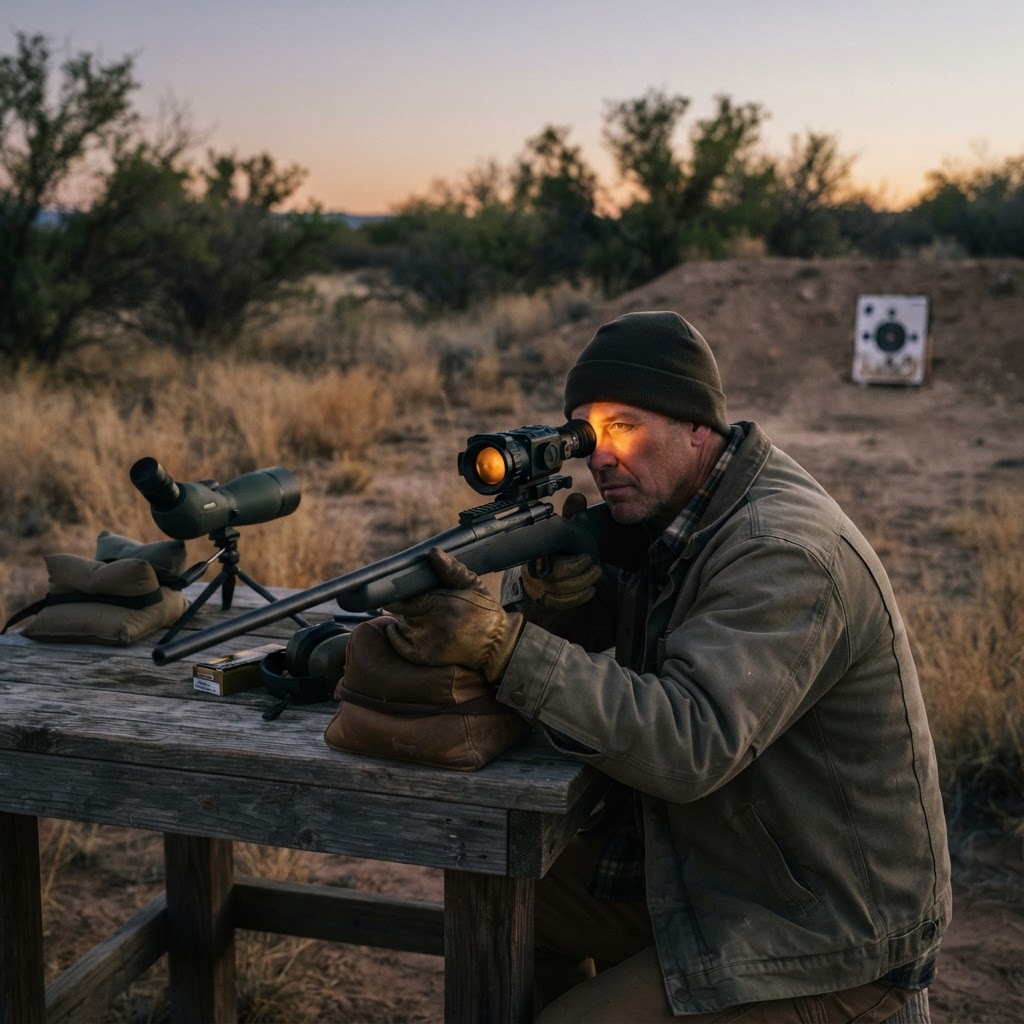
Lead: A thermal scope that is not zeroed is an expensive monocular. Zeroing one is a different process from zeroing a day scope — the reticle is digital, the image has to be focused in two places, and the sensor has to be settled before any group means anything. This is the sequence that produces a zero that is still there next season.
Why a thermal zero is different
Three things change the process compared with a glass optic:
- The reticle is digital. There are no turrets to turn. You move the reticle in the menu, save it, and back out — and the change only counts once it is saved.
- Focus matters twice. The objective focuses the image; the eyepiece focuses the reticle. Get either one wrong and you will chase a group that was never moving.
- The image drifts while the core warms up. A thermal sensor that is still cold-soaking refines itself — the picture shifts and sharpens as it stabilizes. A zero taken two minutes after power-on is not the same zero you get twenty minutes in.
Before you touch the reticle: the mount
Most wandering-zero stories are mount stories, not scope stories. Confirm the rail is true, the rings are torqued to the mount maker's specification and not beyond it, the scope body is not bridging a gap between rail sections, and any threadlocker has fully cured. A thermal scope is heavier than a day scope of similar size, and recoil finds loose hardware quickly.
Step 1: bore-sight at 25 yards
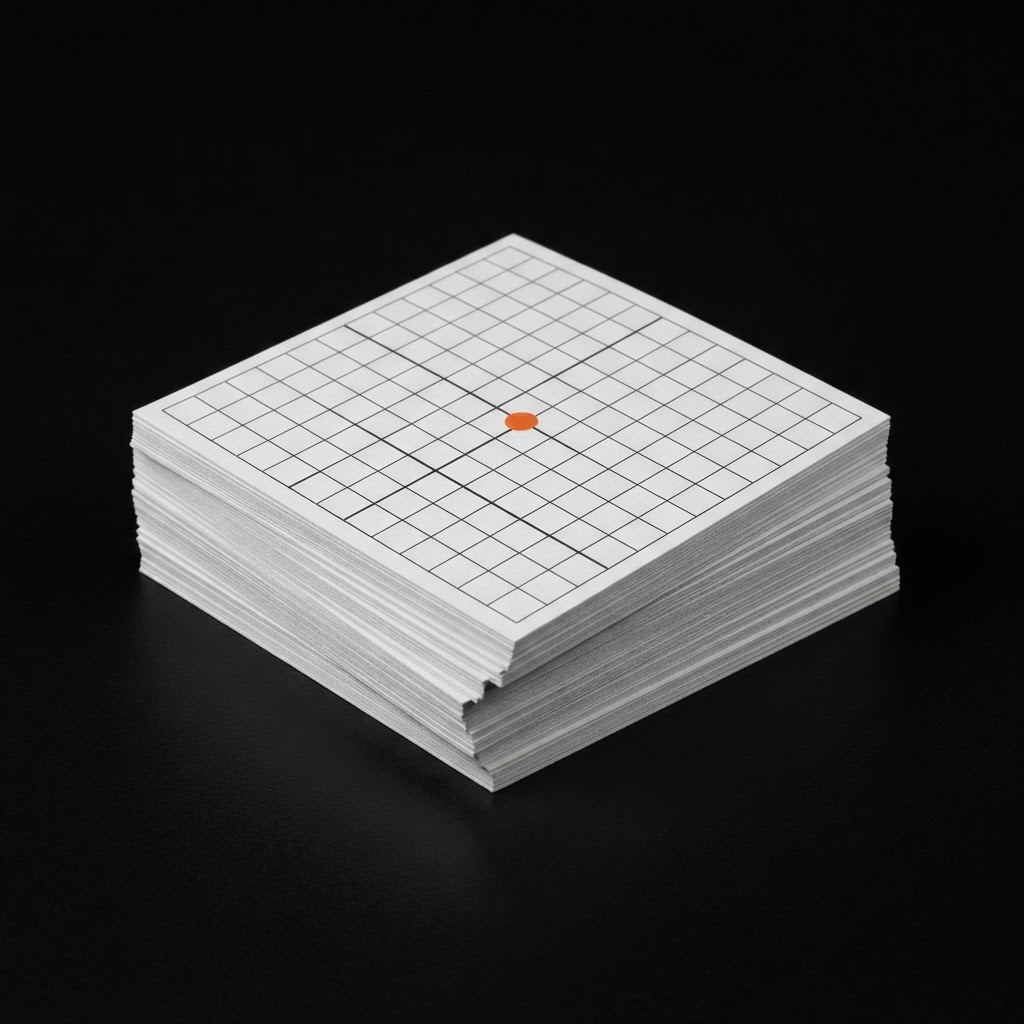
Start on paper at 25 yards with a large-format target — a 12-inch grid with a marked aim point. Bore-sight first so your first shot is on paper, then fire one round. Note where it lands relative to the aim point, move the digital reticle until the crosshair sits on the hole, and save.
This is a coarse step. Its only job is to make step 2 cheap.
Step 2: zero at the range you actually shoot
Zero at the distance you take game at, not at 100 yards because that is the number on the berm. A 50-yard zero and a 100-yard zero put the bullet in different places at 200 — the difference is a clean miss or a wounded animal.
Fire three rounds at the same aim point, let the barrel cool to the same state between groups, and move the reticle to the center of the group — never to a single hole. Then fire a second three-round group to confirm. If the second group is not centered, the first one was not a group.
Step 3: focus and parallax
At the zeroing distance, adjust the objective focus until the target is at its sharpest, then adjust the diopter until the reticle is sharp against it. Repeat once — the two interact, and one pass rarely settles both.
A soft image is not just cosmetic. A blurry reticle is a reticle you place inconsistently, and that reads as a wandering zero on the target.
Step 4: let it cold-soak, then reconfirm
Leave the scope powered for a full warm-up period before you record a final zero, and take one confirming shot at the end of the session. If you zeroed the rifle indoors in a warm shop and then hunt at 20 degrees, expect a small shift — a thermal core that has never seen the cold is a core you have not tested.
Shoot one confirmation round from a cold, settled rifle before the first hunt, not a group. One shot tells you whether the zero moved.
Step 5: write the zero down
Record the ammunition, the bullet weight, the distance zeroed, the ambient temperature, and which saved profile the scope is using. Thermal scopes store multiple profiles, and picking the wrong one before a hunt is a silent way to miss — the reticle is correct for a cartridge you are not carrying.
If you change ammunition, change the profile or re-zero. Do not assume a similar load shoots the same.
Five things that ruin a thermal zero
- Zeroing at maximum digital zoom. Zero at base magnification, then check at zoom. Digital zoom enlarges pixels; it does not move the impact.
- Zeroing with a half-charged battery. A dying battery can drop the core into a lower-power state mid-session, and the picture changes under you.
- Chasing a hot target. A hand warmer or a hot rock makes a wonderful aim point and a terrible reference — its apparent size and edge shift with the display palette and the gain setting you are in.
- Not saving the profile. The single most common cause of "it lost zero at the lease."
- Zeroing once and never rechecking. Reconfirm after any travel, any mount removal, and any hard knock — a fall off a tailgate counts.
The field re-check ritual
Before the first set of the season, and after any travel: power the scope, let it settle, put one round into a paper plate at your zero distance, and confirm. It costs one cartridge and it removes the only variable you cannot control.
A thermal-specific zeroing method
Thermal adds two things a paper target cannot give you: a hot reference point and a freeze frame. Use both.
- Heat the target, not the background. Adhesive heat patches or hand warmers on a paper grid give a high-contrast, measurable aim point at 30–50 yards. On plain paper you are often aiming at nothing.
- Run a manual NUC (non-uniformity correction) before shooting groups. A fresh calibration removes the fixed-pattern noise that makes a group look like it wandered when it did not.
- Use freeze or one-shot zero if the scope has it. Freeze holds the frame while you move the digital reticle onto the impact; one-shot zero moves the reticle to a single recorded impact. Both save ammunition, and both only work if the group is already consistent.
- Move to your hunting distance and confirm. Zero is only proven where you shoot. Three-round groups, reticle to the center of the group — never to a single hole.
- Save the profile, and label it. Ammunition, distance, temperature. Then confirm point of impact once more before the hunt, not during it.
Clip-ons are different. A clip-on ahead of a day optic usually does not need zeroing at all — it needs its display aligned. Confirm the day optic is zeroed, mount the clip-on the same way every time, and apply X/Y image correction only if point of impact is actually off. Chasing a full re-zero on a clip-on that only needed alignment wastes ammunition and confidence.