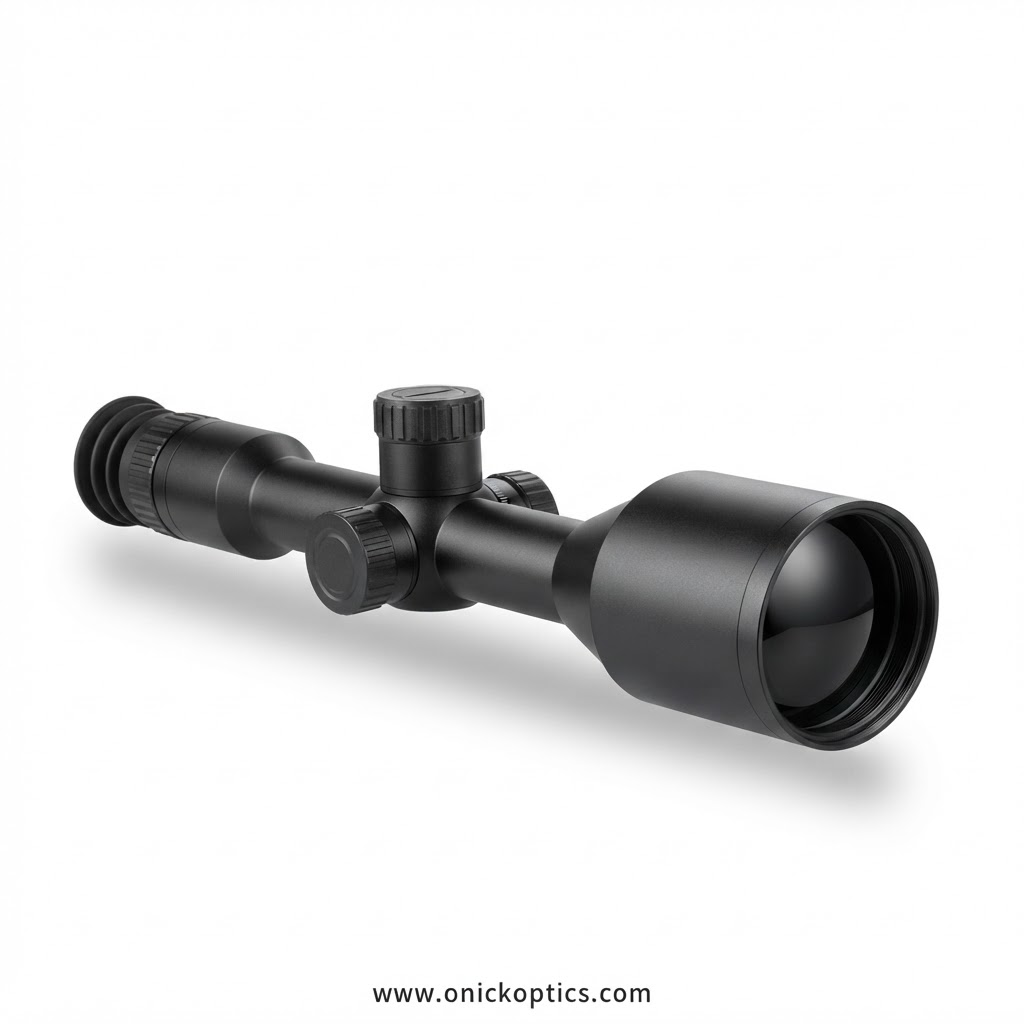

Onick builds two 640-class riflescopes on the same 50 mm optical platform and sells them $145 apart. One carries a laser rangefinder, the other does not. Almost everything else about them is identical, which makes the decision unusually clean: you are choosing a rangefinder, not a scope.
What both scopes share
The RM-612 PRO and the RM-612 LRF are built on the same core and the same glass:
- 640x512 VOx uncooled sensor, 12 µm pixel pitch, 50 Hz refresh, NETD ≤30 mK
- 50 mm objective with an 8.8° x 7.0° field of view
- 2.8x to 22.4x continuous digital zoom, 48 mm eye relief, ±4 diopter
- AMOLED display at 1024x768, 10 reticle types, 0.15 mil adjustment
- 2,600 m (2,843 yd) human detection range
- 32 GB onboard photo and video, Wi-Fi 802.11b/g/n on 2.4 GHz at roughly 10 m
- 6,000 J recoil rating, IP67 sealing, -25 °C to +50 °C operating range
- 30 mm main tube, so the scope takes 30 mm rings, not a Picatinny clamp
If you are deciding purely on image, magnification range and detection distance, the two scopes are the same purchase. Every difference that matters sits in the last two inches of the body and in the battery compartment.
Where the RM-612 PRO earns its place
The PRO is the lighter, longer-running version at 1,030 g and 13 or more hours per charge. It runs two built-in 18650 cells (6,400 mAh) plus an external 18500 pack (2,000 mAh), so you can swap the external cell mid-watch without breaking the internal pair.
At $2,260 it is also the cheaper of the two. What you give up is the rangefinder module, which means the distance in your reticle comes from your own estimate, a separate LRF, or known terrain.
That is a smaller sacrifice than it sounds on a stand you have hunted for years. If your shots come at feeders, food plots or calling lanes where you already know the distance to the edge of the timber, the PRO does the same job with more runtime and less weight.
Where the RM-612 LRF earns its place
The LRF adds a 905 nm laser rangefinder rated to 1,000 m at ±1 m, plus a ballistic calculation function that turns that reading into a firing solution instead of leaving you to do the arithmetic.
The cost is $2,405, 40 g of extra body weight (1,070 g) and one hour less runtime (12 or more hours). Note also that the rangefinder reads shorter than the scope detects: you will see heat at 2,600 m and range it to 1,000 m. That is normal for a hunting-class LRF and matters only if you expect to take shots at the far edge of the scope's detection envelope.
Buy the LRF if your sets change shape through the season, if you hunt open country where a ridge or a treeline sits at an unknown distance, or if you move between properties and cannot rebuild a range card for every stand.
The honest decision rule
- Fixed known distances, long sits, light rifle: RM-612 PRO.
- Variable distances, open ground, one-scope-does-everything: RM-612 LRF.
- Shots you will actually take past 300 yd: neither scope decides that for you. Both top out at 22.4x digital, and the LRF's 1,000 m ranging is the practical limit of the system, so budget the same for ammunition testing either way.
Three checks before you mount one
- Rings, not a clamp. Both scopes are 30 mm tube optics. Order 30 mm rings that also fit your base; a Picatinny clamp designed for a 30 mm body is a different part, and the wrong one will not hold zero under recoil.
- Recoil headroom. The 6,000 J rating covers the hunting cartridges most buyers run, but check your load's muzzle energy rather than assuming. A scope that walks its zero after twenty rounds is usually a mounting problem, not a scope problem, but you want the margin stated up front.
- Weight on the rifle. Around 1,030 to 1,070 g before rings, either scope shifts balance rearward on a light sporter. Handle the rifle with the scope mounted before you commit to a stock or cheek riser.
Both scopes are on the shelf in the Onick lineup, and the full spec sheets sit on each product page so you can compare them line by line.